
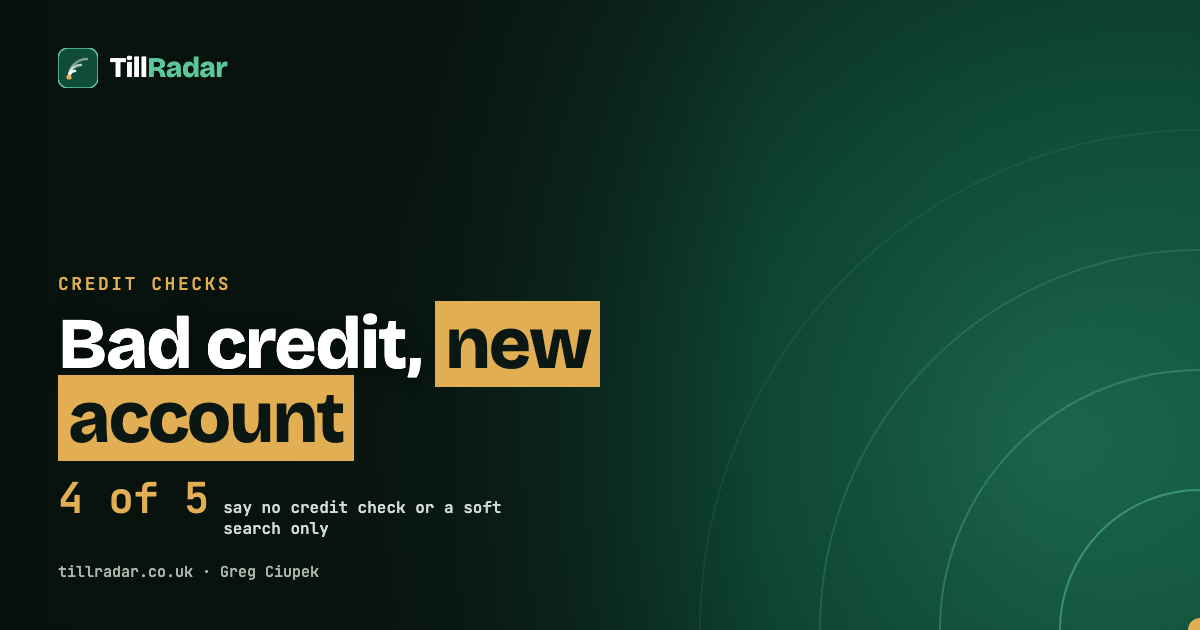
- A business current account with no overdraft is not borrowing, so most providers run a soft search or no credit search at all. A soft search is not visible to other lenders.
- Of 5 providers checked, Zempler says there are no credit checks to open an account. Mettle, Monzo and Starling say their opening checks are soft. Tide does not publish the search type for its account.
- Every provider still runs identity and anti-money laundering checks. Failing those, not a low credit score, is the usual reason an application stops.
- A hard search usually appears only when you ask for credit. Monzo and Starling both say an overdraft application gets a full or hard search.
- If you are an undischarged bankrupt, GOV.UK says you cannot act as a company director without the court’s permission, which affects a limited company application.
This guide is for sole traders and directors with missed payments, a default or county court judgment, or a thin credit history, who want to know whether they will be turned down for an ordinary business current account. It covers current accounts only, not borrowing.
By the end you will know what a soft and a hard search are, what five app-based providers say about their own checks, the real reasons applications are refused, and what to do if one is. Everything below comes from the providers’ own pages and GOV.UK, checked on 4 November 2026.
Do banks run a credit check when you open a business bank account?
Usually they look you up, but the look-up is not the same as the check a lender runs before a loan. When you apply for a current account, the provider needs to confirm that you are who you say you are and that you live where you say you live. Credit reference agencies hold that data, so many providers search them for identity reasons.
The difference is what the search is for and who can see it. A soft search is used to verify you and to check eligibility. It appears on your own credit file but other lenders cannot see it, so it does not affect your score. A hard search is made when you actually apply for credit. Other lenders can see it, and several in a short period can count against you.
An account with no overdraft gives you no credit, so there is little reason for a hard search. Mettle’s blog says its opening checks look at name, address history and citizenship status, not credit history.
Which business accounts say they do not credit check?
We read what each provider says about its own checks. Where a provider does not say, we have written that, rather than repeating comparison sites.
| Provider | Search when you open the account | Where it says so |
|---|---|---|
| Zempler Bank | none “There are no credit checks to open an account” | Help centre, application process FAQ |
| Mettle (NatWest) | soft Electronic identity checks for anti-money laundering, “a soft check”; applying won’t impact your credit score | Mettle FAQ, updated 3 August 2026 |
| Monzo Business | soft Credit reference agencies searched at sign-up to verify identity, check overdraft or loan eligibility and manage business risk: “a ‘soft search'” | Business account privacy notice |
| Starling | soft Quick checks at a UK credit reference agency; “the initial checks leave a soft footprint”. Business accounts’ eligibility checks include “looking at credit data” | Opening an account page; business eligibility page |
| Tide | not stated No statement on the search type for the business account. Its privacy notice says it carries out credit checks “when you apply for some of the Tide Products and Services” | Help centre; privacy notice |
Two points matter here. First, “no credit check” and “soft check” end the same way for your credit score: nothing other lenders can see. Second, a soft search can still be used in the decision. Starling says its eligibility checks for business and sole trader accounts include credit data, and Monzo uses its sign-up search to “manage business risk”. A soft search protects your score; it does not guarantee approval.
Many websites say Tide does not credit check. We could not confirm that on Tide’s own pages: its old help article on credit checks now redirects to a general membership page that does not mention them. Ask Tide in its app chat before you apply.
Can I open a business bank account with bad credit?
In most cases, yes. A low score, a default or a county court judgment is not on the eligibility list of any of the five providers above. What is on those lists is identity, residency, business type and, for companies, the state of the company at Companies House.
The one situation that changes things is bankruptcy. GOV.UK says that while you are bankrupt you cannot act as a director of a company, or create, manage or promote a limited company, without the court’s permission. You also cannot run a business without telling the people you deal with the name you were made bankrupt under. A trustee may also close an existing business. If that is your position, speak to the official receiver or a free debt adviser before applying for anything.
- Sole traders or directors with a low score, old defaults or a paid-off county court judgment
- People with no credit history, such as recent arrivals with a UK address and right to live here
- Businesses in ordinary trades with clear proof of what they do
- Anyone whose identity or address cannot be verified electronically or with documents
- Undischarged bankrupts applying as company directors without court permission
- Businesses in excluded industries, or companies that are dissolved, in liquidation or behind at Companies House
- Applicants with a fraud prevention marker, for example at Cifas, which Monzo says it checks
Why do business account applications get refused?
Providers rarely give a detailed reason, but their eligibility pages show where the walls are.
Identity and address cannot be verified
Tide says it needs proof of identity, address and business, plus a selfie, and cannot accept an application if it cannot verify them. Zempler says that if it cannot verify your identity and address during the application, it will ask for documents. A recent house move, a name change or an address missing from the electoral register can all cause this.
Residency, phone and device rules
Mettle requires you to be a UK resident and UK tax resident only, not a US person for tax, with a UK phone number and an iOS 16 or Android 10 device. Tide needs a UK mobile number and a phone registered to a UK app store. Starling requires every director with access to the account to live in the UK; Zempler asks for at least one UK-resident director.
The business itself
Every provider lists industries it does not serve. Starling’s list includes gambling, used vehicle sales, CBD, antiques and precious metals, and businesses that regularly make significant cash deposits. Tide will not take businesses funded by donations. For companies, Zempler wants an active status and an up-to-date confirmation statement, and Mettle allows no more than two people with significant control.
Tide also asks sole traders to be registered with HMRC. If you have not done that yet, see our guide to opening a business bank account as a sole trader.
When does a hard credit search happen?
When you ask for credit. Monzo’s privacy notice says that if you take out a loan or overdraft for the first time it does “a full search”, which may impact your score. Starling says its overdraft check leaves a hard footprint. Zempler and Tide also offer credit products, directly or through partners, and those come with their own checks.
To keep your file clean, decline any overdraft or credit offer during sign-up. You can bank, get paid and pay suppliers without one.
Monzo’s notice says the sign-up search is used, among other things, to check whether it can offer you an overdraft. The search is still soft. A hard search only follows if you actually take the overdraft. Read every screen before you tap accept.
What does each account cost once you are in?
All five have a free plan, but they charge differently for transfers, cash and cards. If you have been refused elsewhere, check the fees before taking the first yes, especially if you pay in cash.
| Account | Monthly fee | UK transfer out | Paying in cash | Card abroad | Protection |
|---|---|---|---|---|---|
| Zempler Bank (formerly Cashplus)Zempler Business Go | FreeBusiness Go £0; Business Extra £9; Business Pro £19. | £0.353 free payments out a month, then 35p each; paying direct debits is free. | 0.55% (min £4) at the Post Office£6,000/day limit. Zempler limits page: minimum £10 per deposit; check with the Post Office branch before paying in more than £2,000. | 2.99%Non-sterling transactions. | FSCS |
| Mettle (NatWest)Mettle business account | FreeNo fee. Mettle+ is optional at £4 a month. | FreeFree: stated in Mettle's help pages. | £2.75£2.75 per deposit at the Post Office. Limits: £10–£500 per deposit, max £500 a day and £23,000 a year. | Free0% Non-Sterling Transaction Fee on foreign-currency card payments and cash withdrawals; Mastercard exchange rate. | FSCS |
| MonzoMonzo Business Lite | FreeLite is free. Pro is £9/month with the first month free; Team £25/month plus £5/month per member after the first 6 (Ltd max 15 members). | Free'Sending money within the UK: £0'. | £1.00'£1 per deposit to pay in cash at any PayPoint or Post Office'. Minimum £5 per deposit. Per-deposit limits: PayPoint max £300; Post Office sole trader £3,000, Ltd £4,000. Monthly cash limit: £3,000 per calendar month for sole traders, £10,000 for limited companies. | FreeNo fee on foreign-currency card payments. | FSCS |
| Starling BankStarling Business Account | FreeNo monthly fee. Bulk Payments add-on £7/month. Euro account £2/month; US dollar account £5/month (limited companies only, ACH only, no SWIFT; Starling is not taking new USD account applications at the moment). | FreeNo charge. CHAPS £20. | 0.7% (min £3) at the Post OfficePost Office only. Cash limits for sole traders: £5,000 a day and £20,000 a year, as stated on Starling's sole trader account page; its business account page also quotes £100,000, the figure its eligibility page gives for company accounts. Companies: £5,000 a day, £100,000 a year. Minimum deposit £3.01. Businesses that regularly pay in significant cash are not accepted. | FreeNo Starling fee on foreign card spend (Mastercard rate). 0.4% conversion fee on outbound international payments. | FSCS |
| TideTide Business Account – Lite plan (formerly Free) | FreeLite plan (formerly Free): no plan fee. Paid plans: Smart £12.49, Pro £27.49, Max £69.99 a month; yearly Smart £99.99, Pro £219.99, Max £559.92. | £0.2020p per bank transfer, in or out, after 5 free transfers a month on the Lite plan. CHAPS £15. | Post Office £2.50 up to £500, 0.99% above £500 (Lite plan); PayPoint 3%Paid plans pay 0.5% over £500 at the Post Office. Limits: Post Office max £25,000 per deposit, £25,000 a month, £300,000 a year; PayPoint min £10, max £500 a day. | 2.75%Lite plan only; 0% on Smart, Pro and Max. | FSCS |
Fees from each provider's published tariff, checked 22 November 2026. Sorted by the monthly fee after any introductory period. Business tariffs change; the provider's own document always prevails.
For a wider comparison of free plans, see our business bank accounts hub. If you are weighing up Zempler in particular, read our Zempler business account review.
£50 welcome gift when you apply from Zempler's deposit-offer page and deposit £250 within 30 days.
- Apply using an 'Apply' button on zemplerbank.com/landing/business/all/deposit-offer/ and have the account approved and opened.
- Credit the account with at least £250 within 30 days of opening.
- Keep the account active and compliant until the reward is paid, which can take up to 30 days after the deposit.
New business account offers, fee changes and deadlines, in one short email.
How to apply if your credit history is poor
- Check your own file first Fix wrong addresses or accounts that are not yours, because identity checks use the same data.
- Pick a provider whose rules you meet Read its eligibility page for residency, phone, industry and company rules. These cause far more refusals than credit history.
- Have your documents ready Photo ID, proof of address and proof of the business, such as your HMRC registration, invoices or a website. Companies should check their Companies House record is active and the confirmation statement is up to date.
- Say no to credit during sign-up Skip any overdraft or credit offer if you want to avoid a hard search.
- If you are refused, ask why Fix the cause before applying elsewhere.
What can I do if I am refused?
A failed identity check can often be solved with documents. An excluded industry cannot, so look for a provider whose list does not include your trade. Our guide on how long it takes to open a business bank account explains what manual reviews involve.
If you are a sole trader, GOV.UK says you might be able to use a personal account for business transactions, and tells you to check with your bank which type of account you can use. That can tide you over, although keeping business money separate makes your records and your tax return easier. If debt is the underlying problem, free advice is available through GOV.UK’s debt advice pages.
Frequently asked questions
Can I open a business bank account with bad credit in the UK?
Usually, yes. Of the five providers we checked, none lists a low credit score, a default or a county court judgment as a reason for refusal. The checks that matter most are identity, residency, business type and, for companies, Companies House status.
Does opening a business bank account affect my credit score?
Not if the provider runs a soft search or none at all. Mettle, Monzo and Starling say their opening checks are soft, and Zempler says it runs no credit checks to open an account. A hard search, which other lenders can see, normally comes only with an overdraft or loan application.
Does Tide do a credit check for a business account?
Tide does not say on its own pages. Its help centre lists identity, address and business proof plus a selfie, and its privacy notice says it runs credit checks for “some” of its products without naming them. Ask Tide in its app chat if you need a definite answer before applying.
Which business bank account has no credit check?
Zempler Bank’s help centre says there are no credit checks to open an account. Mettle, Monzo and Starling run soft searches, which do not affect your score. All of them still check your identity and may refuse an application for other reasons.
Can a bankrupt person open a business bank account?
GOV.UK says that while you are bankrupt you cannot act as a company director, or create or manage a limited company, without the court’s permission. You can trade again as a sole trader with restrictions, including telling people the name you were made bankrupt under. Speak to the official receiver or a free debt adviser before applying.
Why was my business account application rejected?
The most common published reasons are identity or address that could not be verified, residency or phone rules, an industry the provider does not serve, or a company that is not active at Companies House. Ask the provider which one applied, because some can be fixed with documents.
Sources
- Zempler Bank: Step-by-step business application process (FAQ on credit checks)
- Zempler Bank: Business current account eligibility
- Mettle FAQ: Will applying for a Mettle account affect my credit score? (updated 3 August 2026)
- Mettle: What’s the impact of applying for a business bank account on your credit score?
- Mettle: Eligibility
- Monzo: Business account privacy notice
- Starling: Open a bank account online (the small print)
- Starling: Business accounts eligibility
- Tide: Becoming a Tide member
- Tide: Privacy notice
- GOV.UK: Becoming bankrupt, restrictions and if you’re self-employed
- GOV.UK: Business records if you’re self-employed
Checked on 4 November 2026 against the providers’ published terms. Offers and fees change; the provider’s own documents always prevail.
Ad From the publisher: Boardeon, an AI board for your business · Telofia, an AI receptionist that answers your callsVoxiora, an AI receptionist that answers your calls
Boardeon is run by JG INVEST P.S.A., the publisher of TillRadar; the discount applies if you buy within 7 days of creating your account. Telofia and Voxiora are run by AI AGENT HUB P.S.A., a company connected with the publisher. Affiliate links.